
Please note: This website contains affiliate links. As an Amazon Associate, we earn from qualifying purchases at no additional cost to you.
.
There is a special kind of heartbreak that happens the moment you unroll a brand-new rug, step back, and realize it looks like a postage stamp in the middle of your living room.
It’s a design task that feels entirely straightforward—until you’re standing in an aisle with a tape measure, staring at standard dimensions, and second-guessing your math.
A rug that is too small instantly makes a room feel fractured and unfinished. A rug that is too large can swallow your furniture and overwhelm the space. But when you get the scale right, the entire room clicks into place.
This guide strips away the guesswork and breaks down rug sizing room by room so you can buy with total confidence.
The Universal Golden Rule
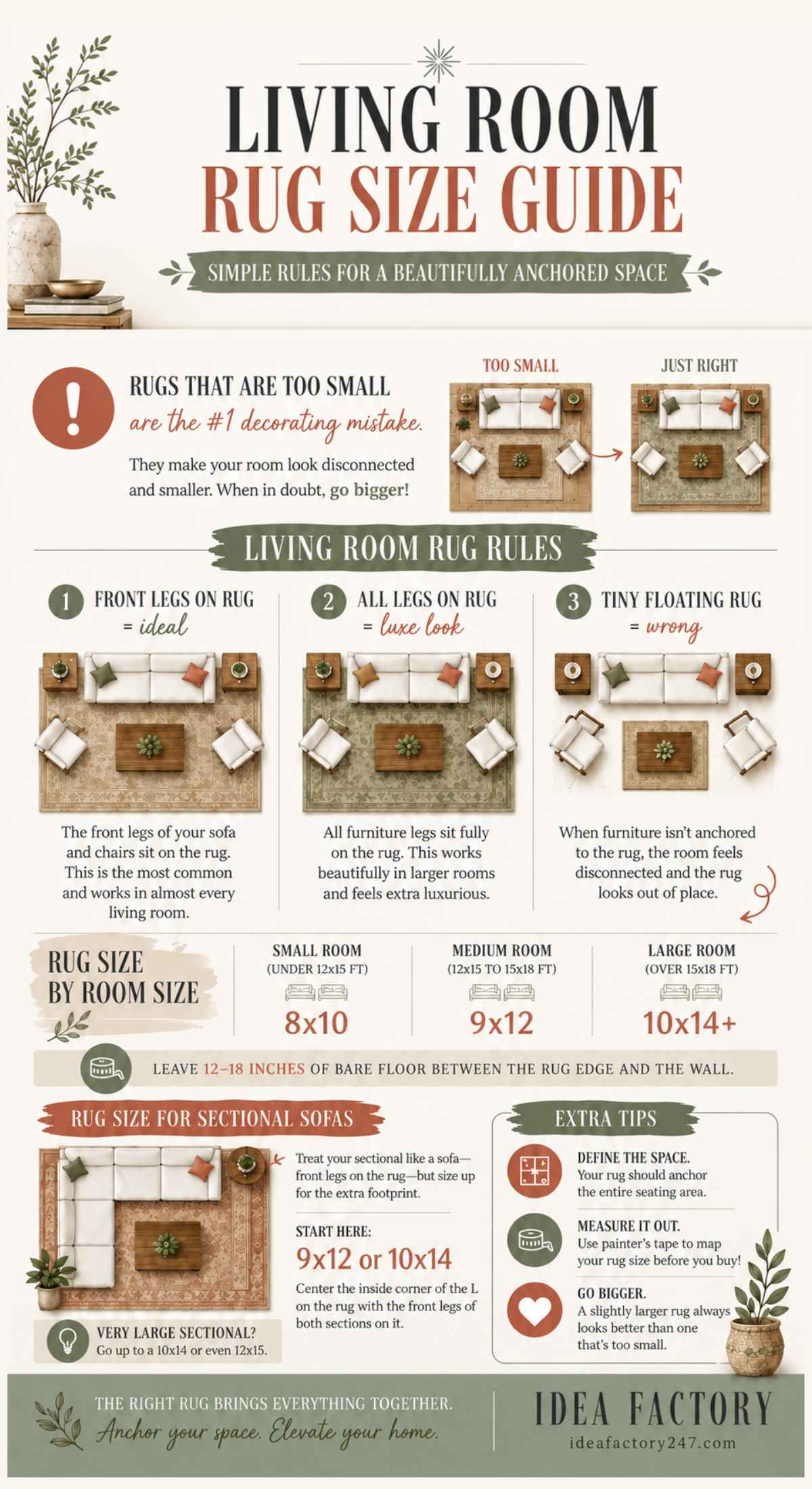
Before looking at specific rooms, keep one principle in mind: under-sizing is the single most common decorating mistake. When you are caught between two sizes, almost always opt for the larger option.
Think of a rug as a frame for your conversation or dining zone. The rug should anchor your furniture grouping—not float isolated beneath a single coffee table while the surrounding pieces sit on bare floor.
Need quick dimensions? Jump down to our Rug Size Cheat Sheet.
Living Room Rug Size Guide
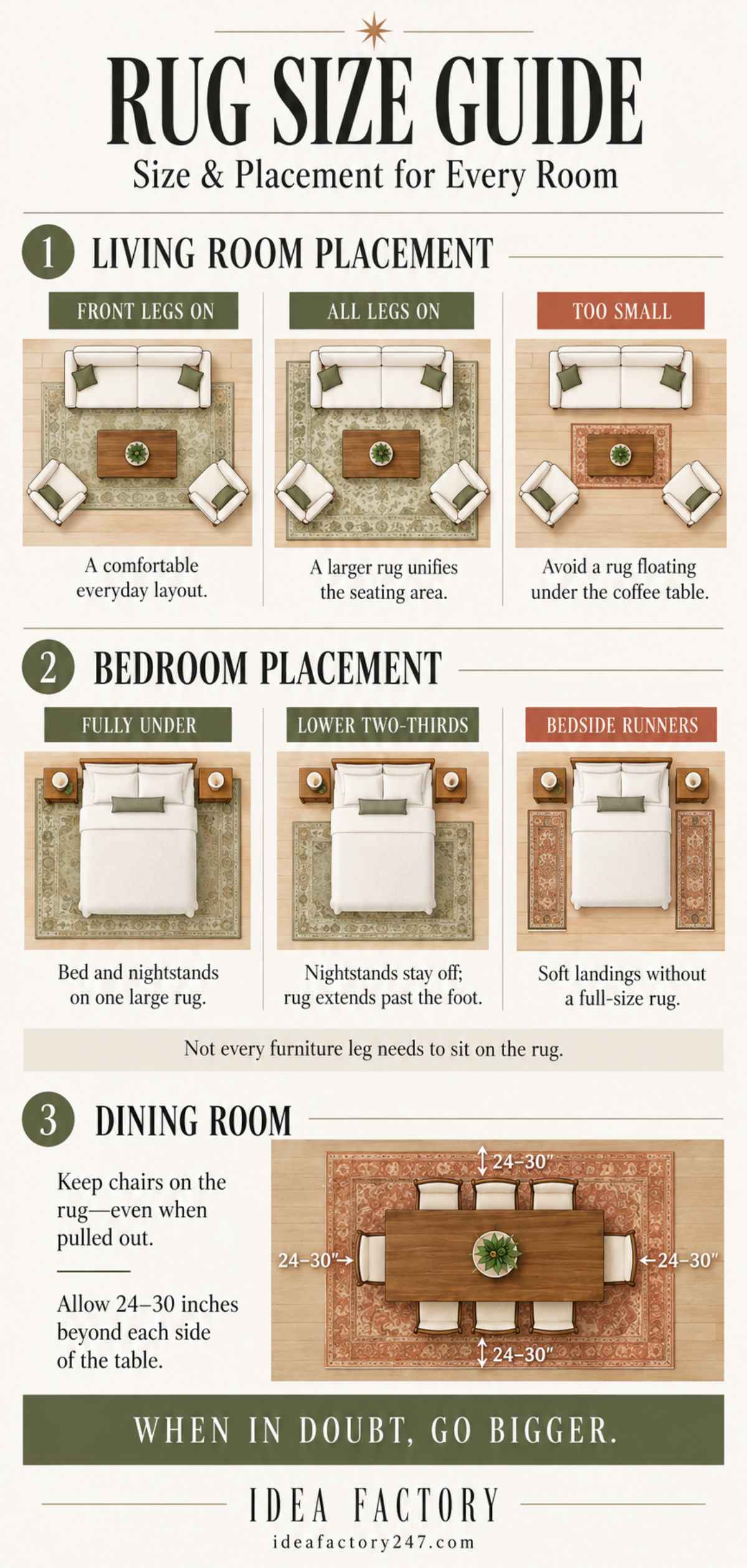
Because living rooms feature varied seating arrangements, they tend to cause the most confusion. To keep it simple, choose one of these three standard placement rules:
- The Standard (All Front Legs On): The front two legs of your sofa and accent chairs sit on the rug, while the back legs rest on the bare floor. This is the most versatile layout and works in almost any standard-sized room.
- The Generous (All Four Legs On): Every piece of main seating furniture sits completely on the rug with a few inches of extra rug border to spare. This approach creates a luxurious, pulled-together feel in open-concept or larger living spaces.
- The Minimum (Front Sofa Legs & Coffee Table Only): At an absolute minimum, the coffee table and the front two legs of your primary sofa must rest on the rug. If your accent chairs can’t touch the rug at all, the size is too small for the room.
Living Room Rug Sizes by Room Size
- Small living room (under 12×15 ft): An 8×10 rug is usually the right call
- Medium living room (12×15 to 15×18 ft): 9×12 is the sweet spot
- Large living room (over 15×18 ft): A 10×14 or larger; consider two rugs in an open-plan space
I woud highly recommend leaving at least 12–18 inches of bare floor between the rug edge and the wall. This border of exposed floor is what makes the room feel intentional rather than wall-to-wall carpeted.
Rug Size for Sectional Couch
Sectionals throw people off because of the L-shape. The key is to treat the sectional the same way you’d treat a regular sofa — front legs on, back legs off — but size up to account for the extra footprint.
For most sectionals, a 9×12 or 10×14 rug is the right starting point. Position the rug so the inside corner of the L sits roughly centered on the rug, with the front legs of both sections landing on it. If your sectional is very large, go up to a 10×14 or even 12×15.
Bedroom Rug Size Guide
Bedroom rugs are all about what you feel when you step out of bed in the morning. The goal is to land on rug, not cold floor — and to frame the bed in a way that feels intentional and cozy.
Rug Size for a King Bed
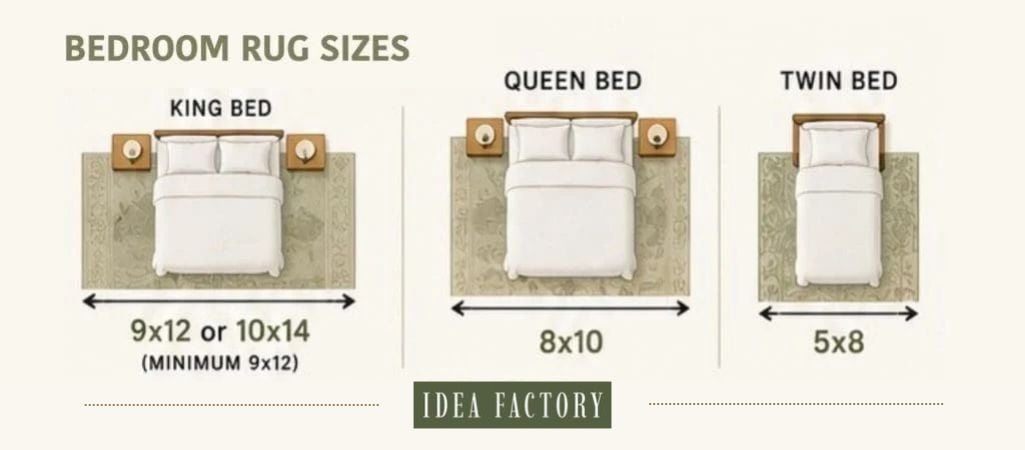
A king bed needs a generous rug to look right. The most common mistake is going with an 8×10, which ends up looking like a postage stamp under such a large piece of furniture.
Best options for a king bed:
- 9×12 — the minimum for a king; works if the room isn’t too large
- 10×14 — the ideal size; gives you 2–3 feet of rug on each side and at the foot of the bed
- 8×10 — only works if you position it at the foot of the bed rather than underneath it (more on placement below)
Rug Size for a Queen Bed
Queen beds are the most forgiving to work with. An 8×10 is usually perfect — it gives you 18–24 inches of rug on each side and at the foot. In a smaller room, a 5×8 placed at the foot of the bed can also work well.
Rug Size for a Twin Bed
For a twin, a 5×8 or 6×9 placed alongside the bed works well. If the bed is against the wall, you only need rug on one side and the foot, so a 4×6 or 5×8 is usually sufficient.
Bedroom Rug Placement Options
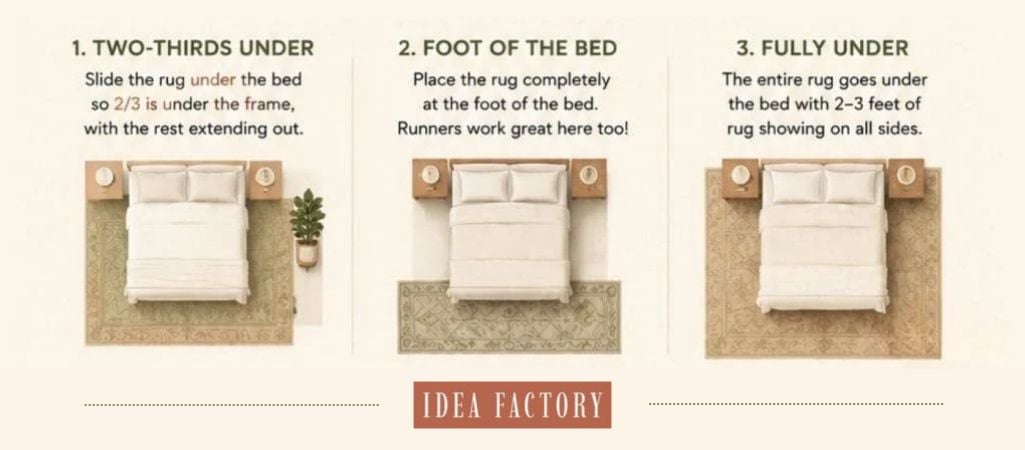
There are three main ways to position a rug in a bedroom:
Option 1: Two-thirds under the bed. Slide the rug under the bed so roughly two-thirds of the rug is under the frame, with the remaining third extending out at the foot. This is the classic approach.
PRO TIP: It’s a little hard to see in the image above, but if you are going with this option, there should be a gap of about 2 to 4 inches in between your nightstand and where the rug begins.
Option 2: Foot of the bed only. Place the rug entirely at the foot of the bed, not under it. Works well with a smaller rug and in rooms where you want to show off a beautiful floor. A runner works well here too.
Option 3: Full under the bed. The entire rug goes under the bed, with 2–3 feet extending out on each side and at the foot. This requires a larger rug but creates the most luxurious, hotel-like effect.
Dining Room Rug Size & Placement
Dining room rugs have one non-negotiable rule: the rug must be large enough that the chairs stay on the rug even when pulled out. If a chair slides off the rug every time someone sits down or stands up, the rug is too small — full stop.
The standard recommendation is to add 24 inches to each side of your dining table to get your minimum rug size. So if your dining table is 36×72 inches, you need a rug that’s at least 84×120 inches (7×10 feet).
Dining Room Rug Sizes by Table Size
- Small round or square table (up to 48″): 6×9 or 8-foot round
- Medium rectangular table (60–72″): 8×10
- Large rectangular table (84–96″): 9×12
- Extra large or extending table: 10×14
Shape Matters in the Dining Room
Round tables look especially good with round rugs — the shapes echo each other and the room feels more cohesive. Rectangular tables work with either rectangular or round rugs, though rectangular is more common and usually easier to size correctly.
Kitchen Rug Sizing Guide
Kitchen rugs are more functional than decorative, and sizing is usually dictated by the layout rather than furniture.
- In front of the sink: A runner (2×6 or 2×8) is the standard and most practical choice
- In front of an island: A runner sized to match the length of the island — usually 2×8 or 3×10
- Open kitchen/dining area: Treat this like a dining room and size accordingly
The main thing to avoid in a kitchen is a rug that’s too wide for the walkway, which becomes a tripping hazard and makes the space feel cramped.
Entryway and Hallway Rug Size Guide
Entryways and hallways are runner territory. The goal is to lead the eye and protect the floor, not to fill the entire space.
- Small entryway: A 2×3 or 3×5 works — just enough to wipe feet and add a moment of warmth
- Larger foyer: A 4×6 or even 5×8 can work if the space is square or rectangular and has room to breathe
- Hallway: A runner sized to leave 4–6 inches of bare floor on each side — usually 2×8 or 2×10 depending on hall length
Home Office Rug Size Guide
Home office rugs are often an afterthought, but they make a real difference in how pulled-together the space feels — and how comfortable it is to work in.
Under the desk: A 5×8 or 6×9 centered under the desk, with the desk chair able to roll on the rug comfortably. Make sure the rug extends in front of the desk so you’re not rolling back and forth between rug and bare floor constantly — that gets annoying fast.
Full seating area: If your office has a chair or small sofa for reading, treat that grouping like a mini living room and size accordingly.
Quick-Reference Rug Size Cheat Sheet
Save this for your next rug shopping trip:
| Room | Furniture | Recommended Rug Size |
|---|---|---|
| Living room (small) | Standard sofa | 8×10 |
| Living room (medium) | Standard sofa | 9×12 |
| Living room (large) | Sectional | 10×14 |
| Bedroom | King bed | 9×12 or 10×14 |
| Bedroom | Queen bed | 8×10 |
| Bedroom | Twin bed | 5×8 |
| Dining room | Small table (up to 48″) | 6×9 |
| Dining room | Medium table (60–72″) | 8×10 |
| Dining room | Large table (84–96″) | 9×12 |
| Kitchen | In front of sink/island | 2×6 or 2×8 runner |
| Entryway | Small | 3×5 |
| Hallway | Standard | 2×8 runner |
| Home office | Under desk | 5×8 or 6×9 |
SAVE THIS FOR LATER!
Rug Size Guide: Frequently Asked Questions
What is the single most common rug size mistake people make?
Buying too small. Most people default to a rug one size smaller than what the room actually needs because smaller dimensions look deceptively large in a store or online. Once placed under actual furniture, an undersized rug shrinks the visual footprint of the room. When debating between two sizes, almost always choose the larger option.
What size rug do I need for a Queen or King bed?
Queen Bed: An 8×10 is standard, though a 6×9 works in smaller bedrooms.
King Bed: A 9×12 is the baseline minimum, while a 10×14 offers a generous, luxurious frame.
Rule of thumb: Ensure the rug extends 18 to 24 inches past the sides and foot of the bed so your feet land on soft carpet when getting up.
What size rug goes under a dining table?
Choose a rug that extends at least 24 inches beyond all sides of the table. This ensures the back legs of the dining chairs remain securely on the rug even when pulled out to sit down, preventing annoying chair-leg catching on the borders.
Do all the furniture legs need to sit on the rug?
Not necessarily. The most popular, versatile layout is front legs on, back legs off for sofas and accent chairs. Placing all four legs on the rug works wonderfully, but requires a larger (and often significantly more expensive) rug. The only strict rule: avoid having no legs on the rug—a completely floating rug looks disconnected from the room.
How far should a rug be from the walls?
Aim for a 12 to 18-inch border of exposed flooring between the edge of the rug and the walls in average-sized rooms. In smaller spaces or narrow hallways, you can narrow this gap down to 6 to 8 inches.
Can a rug ever be too big?
Yes. If a rug sits closer than 12 inches to the wall, it loses its defining border and starts to look like ill-fitting wall-to-wall carpeting. In very tight rooms, an oversized rug can also overwhelm the space and make it feel enclosed.
Does rug size really change how big a room feels?
Substantially. A properly sized rug draws the eye outward to the perimeter of your furniture arrangement, expanding the visual weight of the room. An undersized rug breaks the floor space into disconnected patches, making even large rooms feel cramped.
How do I test rug dimensions on my floor before buying?
Outline the exact dimensions on your bare floor using blue painter’s tape. Place your key furniture pieces within or over the taped box, then step back to the doorway. Viewing the room from the entrance gives you an accurate, honest perspective on visual scale.
What shape rug should I choose?
Align the rug shape with the room geometry or primary furniture arrangement:
Rectangular: Best for standard living rooms, dining rooms, and under beds.
Round: Ideal under round dining tables, in square entryways, or to soften angular furniture layouts.
Runners: Perfect for narrow hallways, along kitchen islands, or on either side of a bed.
Can I layer a smaller rug over a larger one?
Yes. Layering a smaller, patterned, or textured rug (like a vintage piece or hide) over a larger, neutral base rug (like natural jute or sisal) is a great way to use a smaller rug without breaking the proportions of the room.
Can I put an area rug over wall-to-wall carpeting?
Yes, absolutely! Layering a rug over carpet is a great way to define a zone, add color and texture, or protect high-traffic areas in a rental. However, to make it look intentional rather than clunky, keep three key rules in mind:
Vary the Textures: Combine different pile types for contrast. If you have low-pile or plush carpeting, choose a thicker or heavily textured rug (like jute, wool, or high-pile). If you have a plush, shaggy carpet, opt for a flat-weave or thin rug so it doesn’t look overly bulky.
Anchor It with a Non-Slip Carpet Pad: Rugs placed over wall-to-wall carpet have a habit of bunching, creeping, or rippling when walked on. Always place a carpet-to-carpet non-slip pad (specifically designed with a firmer grip for carpet fibers) underneath to keep it flat and stationary.
Go Big Enough: A tiny rug placed over carpet will instantly look like a patch or an attempt to hide a stain. Stick to the same sizing rules—make sure the rug is large enough that your primary furniture anchors it.
Final Thoughts
Finding the best rug for your space isn’t about following a rigid formua, it’s just about figuring out what you’d like the rug to do (other than look pretty!) and sizing it accordingly. It should anchor the furniture, define the zone, and give people somewhere soft to land.
And if you remember nothing else from this article… when in doubt, GO BIGGER! Leave a border of bare floor around the edges, and use painter’s tape before you commit to a purchase.
Let us know if this was helpful for you!
Please note: This website contains affiliate links. As an Amazon Associate, we earn from qualifying purchases at no additional cost to you.
.