
Please note: This website contains affiliate links. As an Amazon Associate, we earn from qualifying purchases at no additional cost to you.
.
If your cuticles are dry, ragged, or your nails just won’t seem to grow, a good diy cuticle oil can genuinely change things.
The problem? Most store-bought versions are loaded with synthetic fragrance, cheap filler oils, and a price tag that doesn’t match what’s actually inside.
The good news: making your own cuticle oil at home is incredibly easy, costs almost nothing, and lets you use the ingredients that are actually proven to nourish nails and support growth. Once you try it, you’ll wonder why you ever bought the bottled stuff.
This guide covers a jojoba-based hero recipe that’s become a staple in my routine, plus a few variations depending on what you’re going for — essential oils, coconut oil, a simple 3-ingredient version, and even how to fill your own cuticle oil pen for on-the-go use.
Why Homemade Cuticle Oil Works Better
Commercial cuticle oils often lead with mineral oil or silicone, which sit on top of the skin rather than absorbing into it. They can make your cuticles look better temporarily without actually delivering moisture where it counts.
When you make your own, you control the base oils — and the best ones for cuticles and nail growth are deeply penetrating, rich in vitamins, and genuinely nourishing.
Here’s what works and why:
Jojoba oil is the gold standard for cuticle care. It’s technically a wax ester, which means its molecular structure closely mirrors the skin’s natural sebum. It absorbs quickly, won’t clog pores, and is rich in vitamin E — one of the most important nutrients for nail strength and growth.
Vitamin E oil directly supports nail bed health and helps repair damaged, peeling cuticles. It also acts as a natural preservative in your blend, extending shelf life.
Lavender essential oil has antimicrobial properties and promotes circulation — both helpful for nail growth. It also smells incredible, which doesn’t hurt.
Lemon essential oil is brightening and helps with any yellowing on the nail plate. Use sparingly as it can be sensitizing in higher concentrations.
Frankincense essential oil is deeply regenerative and one of the best essential oils for skin repair. It’s a quieter choice but a powerhouse.
The Base Recipe: Jojoba DIY Cuticle Oil for Nail Growth
This is the one I come back to every time. Simple, effective, and it works.
What you’ll need:
- 2 tablespoons jojoba oil
- 1 teaspoon vitamin E oil (puncture 2-3 capsules or use liquid)
- 5 drops lavender essential oil
- 3 drops frankincense essential oil
- A small glass dropper bottle (5ml or 10ml works perfectly)
How to make it:
- Pour the jojoba oil into your dropper bottle using a small funnel or pipette.
- Add the vitamin E oil.
- Drop in your essential oils.
- Cap the bottle and roll gently between your palms to combine — don’t shake, as that can introduce air bubbles.
- Label with the date. This blend keeps for up to 12 months stored away from direct sunlight.
How to use it: Apply 1-2 drops to each cuticle and massage in small circles for 30-60 seconds. The massage is important — it stimulates circulation to the nail bed, which is what actually encourages growth. Do this nightly before bed for best results, or any time your hands feel dry.
Variation 1: Essential Oil Cuticle Oil Blend (Customizable)
Once you have the jojoba base down, you can swap and customize the essential oils depending on what your nails need most.
For nail growth:
- 5 drops lavender
- 4 drops rosemary
- 3 drops frankincense
Rosemary oil has gotten a lot of attention for hair growth, and the same circulation-boosting mechanism applies to nails. It’s a great addition if growth is your primary goal.
For dry, damaged cuticles:
- 6 drops lavender
- 4 drops geranium
- 2 drops chamomile
Geranium is incredibly balancing for dry skin and helps with that tight, uncomfortable feeling around the nail bed in winter.
For brightening:
- 5 drops lavender
- 4 drops lemon
- 3 drops orange
Citrus oils are brightening and uplifting, but keep total citrus drops to 4 or under per tablespoon of carrier oil to avoid sensitivity.
Use the same base (2 tablespoons jojoba + 1 teaspoon vitamin E) for any of these blends.
Variation 2: DIY Cuticle Oil with Coconut Oil
Don’t have jojoba on hand? Coconut oil makes a great alternative, especially if you already use it in other DIY beauty recipes.
What you’ll need:
- 1 tablespoon fractionated coconut oil (this stays liquid — regular coconut oil will solidify)
- 1 tablespoon jojoba oil (or swap for sweet almond oil)
- 1 teaspoon vitamin E oil
- 8 drops lavender essential oil
- 4 drops lemon essential oil
Fractionated coconut oil is lighter than regular coconut oil and absorbs more readily into the skin, making it a better fit for cuticle care. The combination with jojoba gives you a slightly richer blend that’s great for very dry or winter-chapped cuticles.
Mix and store the same way as the hero recipe.
Variation 3: Simple 3-Ingredient Cuticle Oil
Don’t have a full essential oil collection? This stripped-down version is just as effective for daily moisture and nail health — and you can throw it together in under two minutes.
What you’ll need:
- 2 tablespoons jojoba oil
- 1 teaspoon vitamin E oil
- 1 drop lavender essential oil (optional, but even one drop makes a difference)
That’s it. The jojoba and vitamin E do the real work here — the lavender is a light touch for scent and its natural antimicrobial properties. This is also a great starting point if you have sensitive skin and want to keep things minimal before experimenting with more complex blends.
Mix directly in a small dropper bottle and use the same way as the hero recipe. It keeps just as long — up to 12 months in a cool, dark spot.
How to Fill a DIY Cuticle Oil Pen
Cuticle oil pens are incredibly convenient for travel, keeping at your desk, or tossing in your purse — and you can easily fill one yourself with any of the homemade recipes above.
What you need:
- An empty cuticle oil pen or twist-up brush applicator (available on Amazon for just a few dollars)
- Your homemade cuticle oil blend
- A small syringe or pipette for filling
How to fill it:
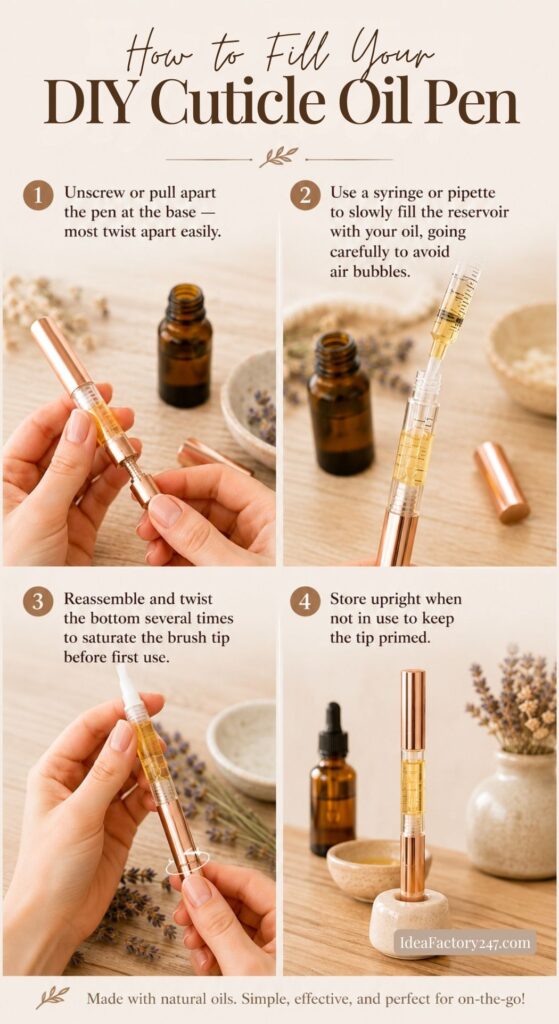
- Unscrew or pull apart the pen at the base — most twist apart easily.
- Use a syringe or pipette to slowly fill the reservoir with your oil, going carefully to avoid air bubbles.
- Reassemble and twist the bottom several times to saturate the brush tip before first use.
- Store upright when not in use to keep the tip primed.
Any of the recipes in this guide work well in a pen — the hero jojoba blend and the 3-ingredient version are both lightweight enough to flow through the brush tip without clogging.
Tips for Getting the Best Results
Consistency matters more than quantity. A tiny amount applied daily will do more than a heavy application once a week. Make it part of your nighttime routine and you’ll notice a difference within 2-3 weeks.
Warm your hands first. Washing your hands with warm water before applying cuticle oil opens the skin slightly and helps the oil absorb better.
Don’t skip the massage. It takes 30 seconds and it’s genuinely the most important part. Circulation to the nail bed is what drives growth — the oil supports it, but the massage activates it.
Store your blends properly. Glass dropper bottles stored away from heat and light will keep your oil fresh for up to a year. Avoid plastic, which can degrade with essential oils over time.
Push, don’t cut. While you’re at it — resist the urge to cut your cuticles. Gently pushing them back after a warm shower is much safer and keeps the protective barrier intact.
DIY Cuticle Oil: Frequently Asked Questions
Can I use olive oil for DIY cuticle oil?
You can, but it’s not ideal as a primary carrier. Olive oil is heavier and can feel greasy on the nail and surrounding skin. It works in a pinch but jojoba or fractionated coconut oil will give you better results for daily use.
How long until I see results?
Most people notice softer cuticles within a few days of consistent use. For nail growth specifically, give it 3-4 weeks — nails grow slowly and it takes time to see a meaningful difference in length and strength.
Can I use this on my toenails too?
Absolutely. The same formula works great on toenails, and the nail growth benefits apply there too.
What if I don’t have essential oils?
The jojoba and vitamin E base alone is still an excellent cuticle oil. Essential oils add therapeutic benefits but the carrier oils are doing most of the heavy lifting for moisture and nourishment.
Is homemade cuticle oil safe during pregnancy?
Some essential oils aren’t recommended during pregnancy — particularly rosemary and lemon in high concentrations. When in doubt, stick to just the jojoba and vitamin E base and check with your doctor before adding essential oils.
Final Thoughts
Making your own cuticle oil takes about five minutes and costs a fraction of what you’d spend on even a mid-range store-bought version. More importantly, you know exactly what’s in it — no fillers, no synthetic fragrance, just ingredients that are genuinely good for your nails and skin.
Start with the hero jojoba recipe, get consistent with daily application and massage, and give it a few weeks. Your cuticles — and your nails — will thank you.
Please note: This website contains affiliate links. As an Amazon Associate, we earn from qualifying purchases at no additional cost to you.
.