
Between cleansers, toners, serums, retinol, moisturizers, and all those little bottles promising glowing skin, figuring out the correct skincare order can feel like solving a puzzle.
Does vitamin C go before hyaluronic acid? Are you supposed to use toner before or after serum? And where on earth does retinol fit into all of this?
If you’ve ever stood in front of your bathroom mirror holding two bottles and wondering which one goes on first, you’re in good company.
The good news? Your skin care routine doesn’t have to be complicated. Once you understand the basic order of application, it’s much easier to figure out which products to use, when to use them, and which steps you can skip altogether.
Below, we’re breaking down the correct skin care routine steps for morning and night, including a few easy-to-save cheat sheets so you don’t have to memorize the whole thing.
Jump to What You Need
- Skin Care Steps in Order: The Quick Answer
- Morning Skin Care Routine Steps
- Night Skin Care Routine Steps
- Where Do Toner, Retinol, and Serums Go?
- The Easy Skincare Order of Application Trick
- Common Skin Care Routine Mistakes
- Simple Skin Care Routine for Beginners
- Frequently Asked Questions
Skin Care Steps in Order: The Quick Answer
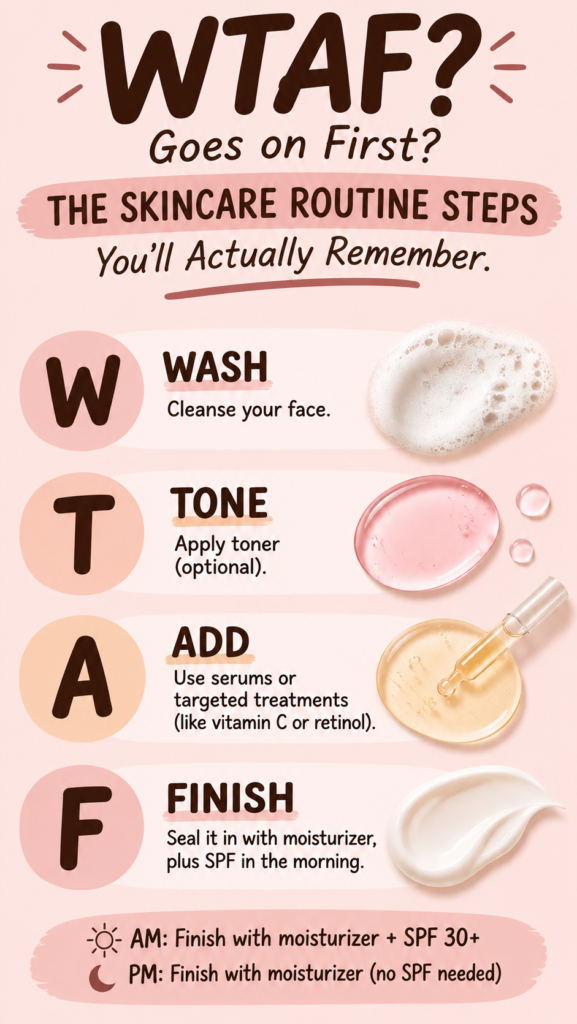
If you just want to know what goes on first, here’s your cheat sheet.
The general rule is to start with clean skin, apply your treatment products, follow with moisturizer, and finish your morning routine with sunscreen.
You may have heard that skincare products should always be applied from thinnest to thickest. That’s a useful guideline for many products, but it’s not an absolute rule. Certain treatments have specific application instructions, and some products work best on dry skin or in a particular order.
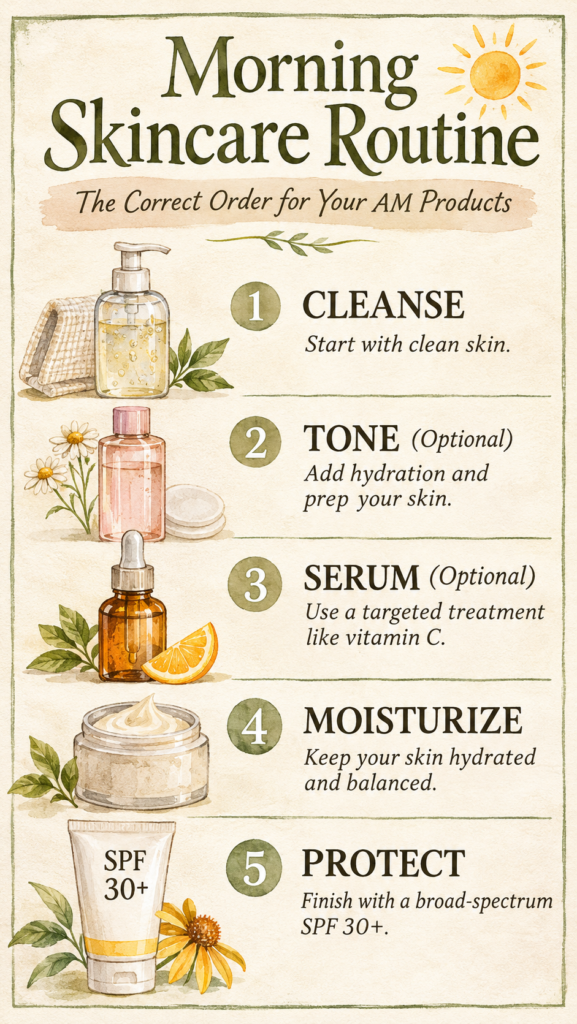
Correct Morning Skincare Order
- Cleanser – Wash away overnight oil and buildup.
- Toner (optional) – Add hydration or address a specific skin concern.
- Vitamin C or another treatment serum (optional) – Target concerns such as dullness or uneven skin tone.
- Hydrating serum (optional) – Add moisture with ingredients such as hyaluronic acid.
- Eye cream (optional) – Apply if you use a separate eye treatment.
- Moisturizer – Help maintain your skin’s protective barrier.
- Broad-spectrum sunscreen SPF 30 or higher – Protect your skin from UV damage.
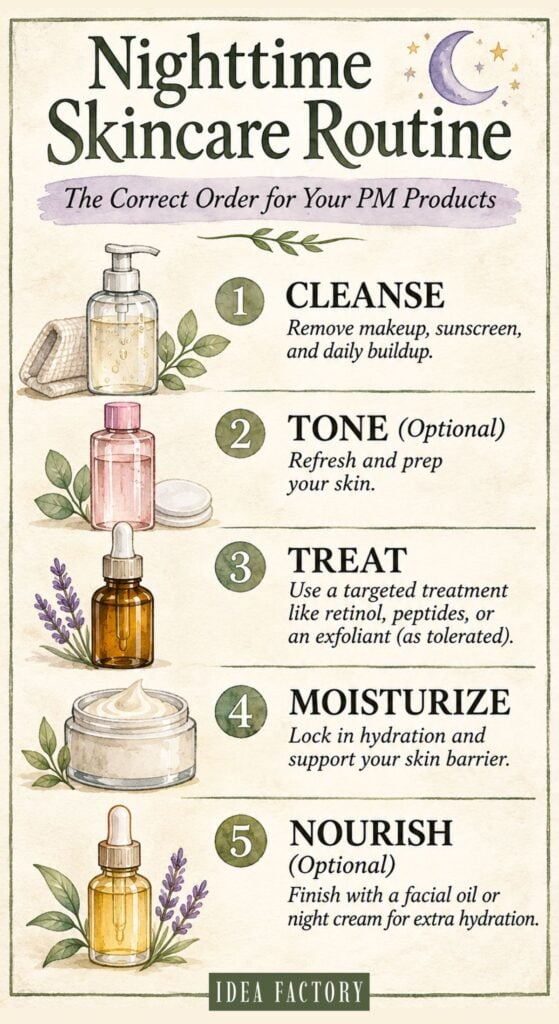
Correct Nighttime Skincare Order
- Makeup remover or cleansing balm (if needed) – Break down makeup and stubborn sunscreen.
- Cleanser – Remove dirt, oil, and remaining residue.
- Toner (optional) – Add hydration or address a specific concern.
- Treatment serum or retinol (if appropriate) – Apply according to the product’s instructions.
- Hydrating serum (optional) – Add moisture if needed, following any treatment-specific directions.
- Eye cream (optional) – Apply your preferred eye treatment.
- Moisturizer – Help replenish hydration and support your skin barrier.
- Facial oil (optional) – Use if it suits your skin and product routine.
Remember: These are possible steps, not a shopping list. You don’t need every product in either routine, and some serums or treatments may need a different order.
Morning Skin Care Routine Steps
Your morning skincare routine has two main jobs: keeping your skin comfortable and hydrated, and protecting it from the sun and environmental stressors.You don’t need an elaborate morning ritual to accomplish either one.
Step 1: Cleanse Your Face
Start with a gentle cleanser suited to your skin type. Cleansing removes excess oil, sweat, and residue that may have accumulated overnight.
Have very dry or sensitive skin? You may find that simply rinsing with lukewarm water in the morning works better than using cleanser twice a day.
Pro tip: Avoid harsh scrubs or cleansers that leave your skin feeling tight and squeaky. That squeaky-clean feeling isn’t necessarily a good thing.
Step 2: Apply Toner (Optional)
Toner goes after cleansing and before most serums and moisturizers.
Modern toners can do several different things. Some provide extra hydration, while others contain ingredients designed to exfoliate or address oily skin.
A gentle hydrating toner may be useful if your skin feels dry, but it’s certainly not essential.
If you’re using an exfoliating toner containing glycolic, lactic, or salicylic acid, treat it as an active skincare product rather than an ordinary hydration step. Follow its instructions and avoid combining too many irritating treatments.
Step 3: Apply Vitamin C Serum (Optional)
Vitamin C is a popular morning treatment because of its antioxidant properties. Depending on the formulation, it may help improve the appearance of uneven skin tone and support protection against environmental oxidative stress.
Apply it to clean skin, typically after toner and before moisturizer, unless the product instructions say otherwise.
Vitamin C doesn’t replace sunscreen, but it can complement a sun-protection routine. If you’re new to vitamin C or have sensitive skin, start with a gentle formulation and introduce it gradually.
Step 4: Apply a Hydrating Serum (Optional)
This is where products containing hyaluronic acid, glycerin, or other hydrating ingredients can fit into your routine.
Hyaluronic acid is a humectant, meaning it attracts and helps retain water. It can temporarily make skin look and feel plumper and more hydrated. Many hydrating serums can be applied before or after other water-based serums. Follow the manufacturer’s directions, particularly when using a treatment that needs to go directly onto clean, dry skin.
And if your moisturizer already contains plenty of hydrating ingredients, you may not need a separate serum.
Step 5: Apply Eye Cream (Optional)
If you use eye cream, this is generally a convenient point to apply it. Use a small amount and gently pat it around the orbital area, avoiding direct contact with your eyes unless the product is specifically designed for that use.
But here’s a little secret: you don’t necessarily need a separate eye cream. For basic hydration, a gentle facial moisturizer may work just fine around the eyes, provided it doesn’t irritate them. Specialized eye products may be useful for particular concerns, but they’re not mandatory.
Step 6: Apply Moisturizer
Moisturizer helps reduce water loss and supports your skin barrier.
Choose a lightweight lotion or gel if you prefer something less rich, or a thicker cream if your skin tends to be dry. Look for ingredients such as ceramides, glycerin, and hyaluronic acid. Even oily skin can benefit from moisturizer. The goal is to find a formula that feels comfortable rather than skipping hydration altogether.
Step 7: Finish With Sunscreen
Sunscreen is the most important morning skincare step for preventing sun-related skin damage and premature aging.
Choose a broad-spectrum sunscreen with SPF 30 or higher and apply it generously to exposed skin, including your face, neck, and ears. Sunscreen should be the final step of your morning skincare routine, before makeup. Reapply at least every two hours when outdoors and after swimming or sweating, according to the product label.
If you use a moisturizer with SPF, it can provide protection when applied in a sufficient amount, but many people don’t use enough moisturizer to achieve the labeled SPF. A separate sunscreen can make adequate coverage easier.
Night Skin Care Routine Steps
Your nighttime skincare routine is when you remove the day’s buildup, moisturize, and use treatments that may be better suited to evening application.
This is also where things can get confusing, particularly when retinol, exfoliating acids, and multiple serums enter the picture. The key is to avoid treating every active ingredient as something you need to use every night.
Step 1: Remove Makeup and Sunscreen
If you wear makeup or water-resistant sunscreen, start with a cleansing balm, cleansing oil, or makeup remover.
This first step helps dissolve products that may be difficult to remove with a gentle cleanser alone. You don’t necessarily need to double cleanse every night. If your regular cleanser removes everything effectively without irritating your skin, one cleanse may be enough.
Step 2: Wash With a Gentle Cleanser
Follow with a gentle facial cleanser to remove remaining residue. Use lukewarm rather than hot water, and pat your face dry with a clean towel.
Quick tip: If you’re planning to apply retinol, make sure your skin is fully dry first, unless your particular product instructs otherwise. Applying retinoids to damp skin can increase irritation for some people.
Step 3: Apply Toner (Optional)
A hydrating toner can go on after cleansing.
If you’re using an exfoliating toner, be more cautious. Combining exfoliating acids with retinol in the same routine can increase dryness and irritation, especially when you’re first starting out.
You may prefer using exfoliating treatments on separate nights from retinol.
Step 4: Apply Retinol or Another Nighttime Treatment
Retinol is a vitamin A derivative commonly used to improve the appearance of fine lines, uneven pigmentation, and skin texture. Certain retinoids are also used to treat acne.
Retinol is generally used at night because some formulations are sensitive to light and because nighttime use makes it easier to manage a consistent routine.
If you’re new to retinol, start with a low-strength product a couple of nights per week and increase gradually as tolerated. A pea-sized amount is generally sufficient for the entire face, though you should follow your product’s directions. Avoid the corners of your nose, lips, and delicate eye areas unless the product is specifically intended for those locations.
What if retinol makes your skin dry?
Try the moisturizer sandwich method:
- Apply a thin layer of moisturizer to clean, dry skin.
- Let it settle, then apply your retinol.
- Finish with another layer of moisturizer.
This approach can help reduce irritation, although it may alter how a particular formulation is delivered. Follow any prescription directions from your dermatologist.
Important: Retinoids are generally avoided during pregnancy and when trying to conceive. If you’re pregnant, planning pregnancy, or breastfeeding, ask your healthcare professional before using retinol or other retinoids.
Step 5: Add Hydration if Needed
If your skin feels dry, a gentle hydrating serum may help. Ingredients such as hyaluronic acid, glycerin, and panthenol can support hydration without requiring another strong treatment.
Some hydrating serums are best applied before retinol, while others may be used afterward. Product instructions take priority, and you don’t need to layer several serums just because you own them.
Step 6: Apply Eye Cream (Optional)
If you use a nighttime eye cream, apply it according to its directions.
Some eye products contain retinoids or other active ingredients, so avoid layering them with additional irritating treatments around the eyes unless advised by a professional.
Step 7: Apply Moisturizer
Moisturizer is particularly helpful at night if you’re using retinol or other ingredients that can cause dryness. A cream containing ceramides, glycerin, or other barrier-supporting ingredients can help keep skin comfortable.
If your skin is very dry, a richer moisturizer may be more suitable than the lightweight product you use in the morning.
Step 8: Finish With Facial Oil (Optional)
Facial oil can be a finishing step if you enjoy using one and your skin tolerates it. Oils help soften skin and may reduce moisture loss, but they don’t replace the water-binding ingredients and barrier support provided by a well-formulated moisturizer.
Note: Not everyone needs facial oil, and some formulas may be too heavy for acne-prone skin.
Skincare Order of Application: Where Does Each Product Go?
Still wondering where a particular bottle fits? Here’s a quick reference for common skincare products and their usual place in a routine.
| Product | When to Apply |
|---|---|
| Cleansing balm or makeup remover | Before cleanser, when needed |
| Facial cleanser | First cleansing step |
| Hydrating toner | After cleansing |
| Exfoliating toner | After cleansing, according to directions |
| Vitamin C serum | Usually before moisturizer; often AM |
| Hyaluronic acid serum | Typically before moisturizer |
| Niacinamide serum | Usually before moisturizer |
| Retinol | Usually PM, according to product directions |
| Peptide serum | Generally before moisturizer |
| Eye cream | According to formulation; often before moisturizer |
| Moisturizer | After most treatments |
| Facial oil | Often after moisturizer |
| Sunscreen | Last morning skincare step |
Does Serum Always Go Before Moisturizer?
Usually, yes. Many serums are designed to be applied before moisturizer so their ingredients can reach the skin without having to pass through a heavier cream first.
But there are exceptions, especially when using retinoids or prescription treatments. Always check the directions for your particular product.
Can You Use More Than One Serum?
Yes, but that doesn’t mean you should use every serum in your cabinet at once.
A hydrating serum and a vitamin C serum, for example, may work well together. But layering several exfoliating or irritating treatments can leave your skin red, dry, or uncomfortable.
Choose products based on your actual skin concerns rather than trying to use everything every day.
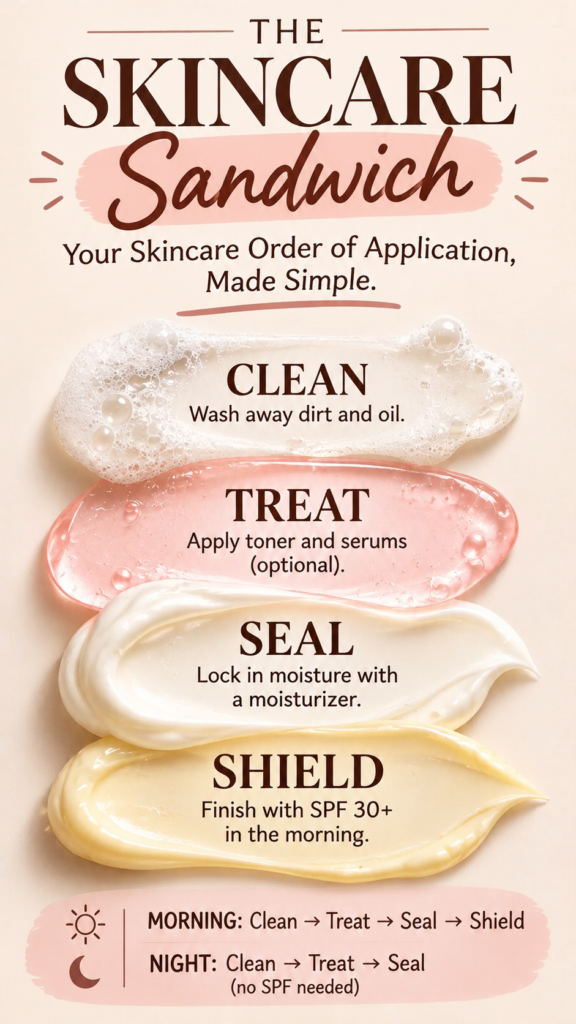
The Easy Skincare Order of Application Trick
If you’re struggling to remember the correct skincare order, here’s a simple trick:
Cleanse → Treat → Moisturize → Protect
Think of these as the four main stages of your skincare routine.
CLEANSE: Start with clean skin.
TREAT: Apply the serums or treatments you’ve chosen for your skin concerns.
MOISTURIZE: Help maintain hydration and support your skin barrier.
PROTECT: Finish with sunscreen in the morning.
At night, you can skip the sunscreen step and focus on cleansing, appropriate treatments, and moisturizing.
It’s not a perfect guide to every individual product, but it’s an easy way to remember the overall sequence.
And if you forget? That’s what the cheat sheets are for.
Common Skin Care Routine Mistakes
Even when you’re using good products, a few common mistakes can make your routine less effective or unnecessarily irritating.
Using Too Many Active Ingredients
Retinol, exfoliating acids, benzoyl peroxide, and other active treatments can all be useful, but combining several at once may overwhelm your skin.
Introduce one new active ingredient at a time so you can see how your skin responds.
Applying Products in the Wrong Order
Some products work best when applied directly to clean skin, while others are intended to be layered over moisturizer.
Don’t rely exclusively on the thinnest-to-thickest rule. Follow treatment instructions, especially for prescription products.
Skipping Moisturizer Because Your Skin Is Oily
Oily skin can still become dehydrated or irritated. A lightweight, noncomedogenic moisturizer may help maintain your skin barrier without feeling greasy.
Forgetting Sunscreen
You can spend a fortune on serums, but daily UV protection remains one of the most important steps for maintaining healthy-looking skin. Use broad-spectrum SPF 30 or higher and reapply when needed.
Expecting Results Overnight
Hydrating products may make skin feel more comfortable relatively quickly, but treatments for acne, pigmentation, and fine lines often require weeks or months of consistent use.
Remember: More product doesn’t necessarily mean faster results!
Changing Everything at Once
If you introduce five new products in the same week and your skin becomes irritated, figuring out which one caused the problem can be difficult. Start slowly and give your skin time to adjust.
Simple Skin Care Routine Steps for Beginners
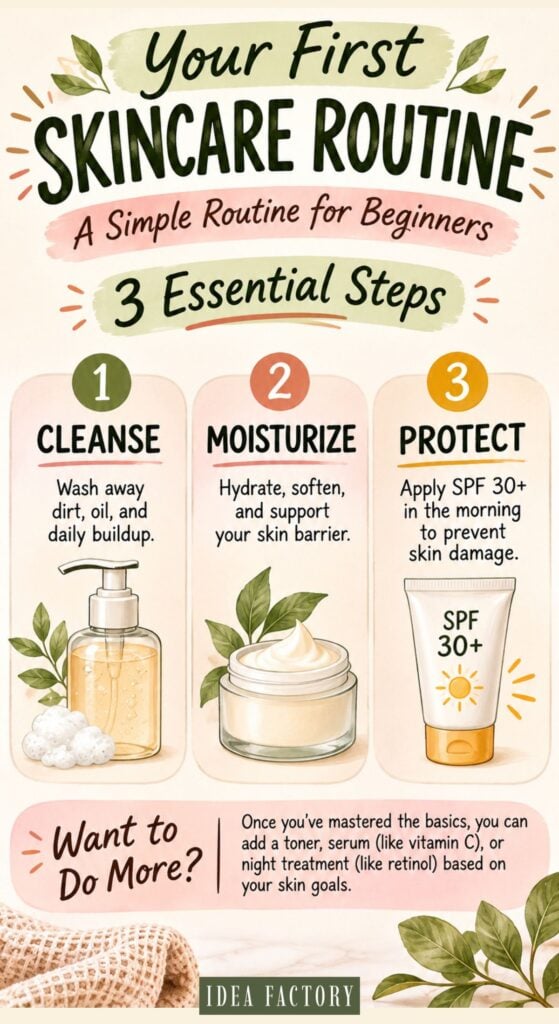
If you’re new to skincare, you don’t need a bathroom counter that looks like a beauty supply store.
Start with the basics.
Your Simple Morning Routine
- Gentle cleanser (or rinse with water if appropriate for your skin)
- Moisturizer
- Broad-spectrum SPF 30+ sunscreen
Your Simple Night Routine
- Gentle cleanser
- Moisturizer
That’s it!
Once you’ve established a routine that works for your skin, you can consider adding a treatment for a specific concern. For example, vitamin C may be useful if you’re concerned about uneven skin tone, while a retinoid may help with acne or visible signs of photoaging.
But additional products should have a purpose. You don’t need a serum simply because everyone on social media seems to own one.
Does Your Skincare Routine Change After 40?
The basic skin care steps stay the same as you get older, but your skin’s needs may change.
As skin ages, it may become drier, more sensitive, or more prone to visible fine lines and uneven pigmentation. Hormonal changes, including those associated with menopause, can also affect skin hydration and barrier function.
You may find that a richer moisturizer, gentler cleanser, or carefully introduced retinoid becomes more useful.
But you don’t need an entirely different application order.
The foundation remains the same: cleanse gently, use appropriate treatments, moisturize, and protect your skin from the sun.
Frequently Asked Questions
The basic order is cleanser, optional toner, appropriate treatment serums, moisturizer, and sunscreen in the morning. At night, remove makeup and sunscreen, cleanse, apply suitable nighttime treatments, and finish with moisturizer. Individual products may have different instructions.
Toner usually goes before serum, immediately after cleansing. However, some exfoliating toners contain active ingredients that require extra care, so follow the product’s directions.
Many routines apply vitamin C first and hyaluronic acid afterward, before moisturizer. However, the correct order can depend on the formulation. Some hydrating serums may be applied first, and many products already combine both ingredients.
Some people can tolerate vitamin C and retinol in the same routine, but using vitamin C in the morning and retinol at night is often a simpler approach, particularly for sensitive skin.
No. Toner and serum are optional steps. Choose them based on your skin’s needs rather than assuming every routine requires both.
Retinol is commonly applied before moisturizer, but applying moisturizer first can help reduce irritation for some people. Follow your product’s instructions, especially if you’re using a prescription retinoid.
A typical morning routine is cleanser, optional toner, treatment serum, hydrating serum if needed, moisturizer, and broad-spectrum sunscreen SPF 30 or higher.
A typical nighttime routine is makeup remover if needed, cleanser, optional toner, appropriate treatment products, and moisturizer. Hydrating serums, eye cream, and facial oils can be added when useful.
Absolutely not. A consistent routine built around gentle cleansing, moisturizing, and sun protection can be effective. Additional products should address specific concerns rather than simply increasing the number of steps.
Final Thoughts: Keep Your Skincare Routine Simple
The correct skincare order isn’t nearly as complicated as the beauty industry sometimes makes it seem.
Start with clean skin, use the treatments that make sense for your needs, follow with moisturizer, and don’t forget sunscreen in the morning.
You don’t need every toner, serum, facial oil, and miracle cream on the market. In fact, a simple routine that you actually follow is often much more useful than an elaborate one you can barely remember.
And the next time you’re standing in front of your bathroom mirror wondering whether the little amber bottle goes before the frosted glass one, come back to these skincare order cheat sheets.
Your face—and your bathroom counter—will thank you.